
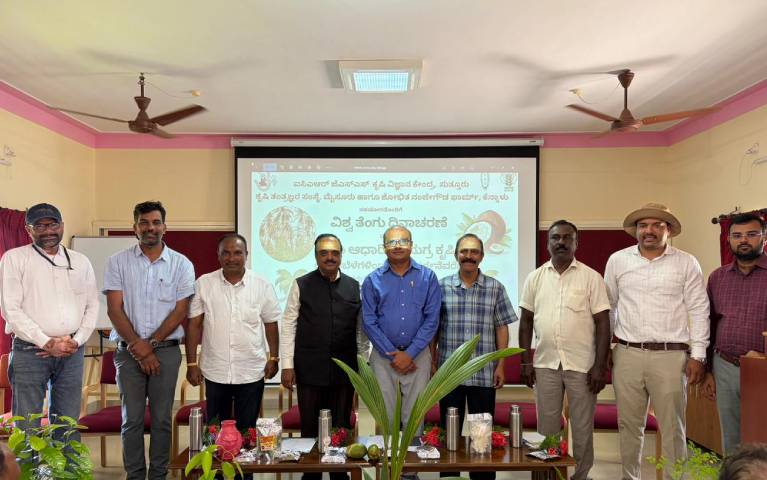
Suttur, September 2, 2026: As part of World Coconut Day 2026, observed under the theme “Coconut in Times of Uncertainty: Securing Food, Energy and Livelihood,” a programme on “Coconut-based Integrated Farming: From Intercropping to Value Addition” was organised at ICAR-JSS Krishi Vigyan Kendra (KVK), Suttur, on September 2.
The programme was jointly organised by ICAR-JSS Krishi Vigyan Kendra, Suttur; the Institute of Agricultural Technologists, Mysuru; and Shobhit Nanjegowda Farm, Kennalu, with the objective of creating awareness among farmers about scientific coconut cultivation, intercropping, integrated crop management, value addition, processing and marketing.
Scientific Management and Value Addition Essential for Sustainable Income: Dr. Hanchimani
Inaugurating the programme, Dr. Hanchimani, Dean, College of Horticulture, Mysuru, said that coconut is one of the most important horticultural crops in the world and a major economic crop in India, Karnataka and Mysuru district.
He observed that coconut is not merely a cash crop for farmers but also an important source of nutrients for the human body. Various coconut-based products make a significant contribution to food, fuel and livelihood security, he said.
Dr. Hanchimani stressed that farmers should aim to earn a continuous and sustainable income from coconut cultivation through scientific management and value addition. In the present context of climate change, erratic rainfall and drought, stabilising the productivity of coconut plantations and farmers’ income has become increasingly important.
He said that intercropping and value addition have a vital role in improving the profitability of coconut plantations. Depending on local conditions, farmers can cultivate crops such as banana, cocoa, vegetables, spices and flower crops as intercrops in coconut gardens. This enables efficient utilisation of land, water and sunlight while providing farmers with additional sources of income.
Instead of selling coconuts only as raw produce, farmers can enhance their returns by processing them into coconut oil, coconut chips and other value-added products and marketing them effectively, he said. He therefore advised farmers to give equal priority to processing, value addition and market linkages, along with coconut production.
Good Management in the Initial Years Determines Long-Term Productivity: Dr. Gyanesh B. N.
Presiding over the programme, Dr. Gyanesh B. N., Senior Scientist and Head, said farmers should first assess the availability of water in their coconut plantations.
He stressed that proper management during the initial stages of a coconut plantation is crucial and that priority should be given to adequate irrigation, nutrient management, weed control, and pest and disease management.
“If coconut plants are managed scientifically during their initial years, they establish well, grow vigorously and provide good yields and a steady income in the later years,” he said.
Dr. Gyanesh added that intercropping in coconut plantations offers considerable scope for enhancing farmers’ income. Crops such as cardamom, avocado and black pepper can provide attractive returns when cultivated under suitable conditions.
However, he advised that intercrops should be selected carefully based on the availability of water, soil characteristics, light intensity and local climatic conditions.
He further said that selection of high-quality seedlings, proper spacing, scientific nutrient management and water conservation are important factors in achieving higher productivity and income.
To maintain soil health in coconut plantations, farmers should give priority to the use of organic manures, biofertilisers and biopesticides, he said. By adopting environmentally friendly and integrated crop management practices, farmers can ensure sustainable production over the long term. He also recommended the adoption of precision agriculture wherever feasible.
Technical Sessions and Practical Training
During the programme, Dr. Siddappa provided technical information to farmers on “Coconut-based Intercropping and Integrated Crop Management in Coconut.” He explained scientific approaches to utilising the space and resources available in coconut plantations through suitable intercropping systems.
Mr. Nagesh Babu of Nisarga Naturals, Tumakuru, conducted practical training on coconut value addition, processing and marketing. He explained the production and processing of coconut oil, chips and other value-added products, along with available market opportunities and the additional income farmers can generate through processing.
Dr. Ramegowda provided information on the major pests affecting coconut and their integrated management, helping farmers understand measures for effective and sustainable pest control.
Mr. Chandrashekhar of Nanjegowda Farm briefed the farmers on the availability of coconut seedlings and nursery management technologies.
Farmer–Scientist Interaction
A farmer–scientist interaction was also held as part of the programme. Dr. Ravindra of the Institute of Agricultural Technologists, Mysuru; Dr. Vinay G. M.; Dr. Prasad Y. P.; Dr. Deepak; Smt. Divya H. V.; and Mr. Shamraj, scientists from KVK, participated in the interaction.
The experts responded to various questions raised by farmers and provided technical guidance on coconut cultivation, intercropping, crop management, soil health, pest and disease management, value addition and related issues.
More than 120 farmers, including members of the Institute of Agricultural Technologists, KVK staff and coconut growers, participated in the programme and benefited from the technical sessions and interaction.
The programme concluded with the message that farmers can achieve stable and higher incomes even amid climate uncertainty by adopting good management practices during the early stages of coconut cultivation, scientific intercropping, the use of organic inputs, and value addition and processing of coconut products.